Donnerstag, 29. August 2019

Sword of Cepheus

What is old school?

  • Imagine, you would like to play a fantasy game where the characters are the heroes, but not that kind of heroes who win in hand-to-hand combat against hordes of ogres and trolls. But the kind of heroes that use their cleverness and cunning. Heroes that might have a home and a job, in a fantasy world that has a bit of magic but also has more mundane traits.
  • Imagine that rpg has very simple rules. Just roll 2d6 and check the result for any task. The character sheet is not more than a few lines of simple text.  Not four sheets of paper, but something that you could take with you on a credit card size piece of paper.
  • Imagine, that you would not start adventuring as a young adolescent, but as someone who has live a life for 30 or 40 years and is on that epic quest of his life now.


Sword of Cepheus


That game for me is Sword of Cepheus. It is built on the established Cepheus Light rules engine that itself emulates a more streamlined version of the original Traveller game. It will be a not a 300 pages tome of intricate details, but rather a quick and fun way to play. The game uses the typical life path character generation, i.e. you not only roll for the attribute values but also for the career, skills and possessions of the character.
Omer Golan-Joel and his coauthors have made a beautiful game here that I had the honor and pleasure to playtest. I can’t wait for the game to be released.
Allow me to share my impression based on the playtest which isn’t the final version of the game, yet.

  1. It feels more real, because danger is less abstract. Being hit with a sword is really threatening, because it may very well take a character out. He or she likely will not die on the spot as in simpler hit-point based system, but the chances for passing out because of damage is high enough. Wounds also don’t just heal that quickly.
  2. I like that armor is reducing damage. Yes, there are many arguments that have been had whether armor should make a person harder to hit. But it feels more rewarding to a player, when the armor reduces that two or three critical points that made the difference between life and death.
  3. Magic is rare and has potentially devastating consequences for the magician if done incorrectly. 
  4. Characters are in general more ordinary people and not superheroes. That fits to it feeling more real.
  5. If you really want superheroes than there are optional rules for that as well.
  6. Character progression is less about boosting stats, but more about acquiring status, influence and wealth. There are rules for trade and hirelings.

To put it in another way: maybe some of you remember how playing the Keep on the Borderlands felt in the day. Sword of Cepheus manages to produce that kind of feeling for me. I can explore a new world with it, which is fascinating, yet dangerous.

For more info, see the old announcement from January http://spacecockroach.blogspot.com/2019/01/announcing-sword-of-cepheus.html

I will update the link, to the full announcement when the game is officially released.

Sonntag, 10. März 2019

Dragon Heresy at HeinzCon 2019

This is a short report on my Dragon Heresy session from HeinzCon 2019.


Since, I guess, most people never have heard of HeinzCon let me just say it is smaller local con in the North of Germany which is hosted by Clockwork Publishing (Space 1889 and Dark Conspiracy) [1].

Dragon Heresy is a setting for 5e that is based on a fictional version of the Norse mythology. So it is based in a Viking-like world. Douglas Cole did a great job with the Introductory Book which is a self-contained  hardcover that allows to play characters from level 1 to 5. Self-contained means you only need that book and no other 5e material (no players handbook). I wrote the session for the con using only that book, so it works. [2]

I had 5 pregenerated characters: a human berserker, a human fighter, a human skald, a drwaven cleric and a half-elf wizard. Each was level one, so we could immediately start to play.

In order to show the features of the game, I had them start a teenagers around 17 or 18 years and they would start on the day of their right of passage. (The book says that age should be 16 in Thorengar, but I adjusted a bit). The first scene was the characters standing in front of their Jarl, who challenged them to prove their worth.

Some local farmers were losing cattle to some malicious wolf over the last week and the group should take care of the problem, but before they could: as a rite of passage they had to win an unarmed fight against two veteran bodyguards from the village.

In game terms we had then a Flything between the veterans and the players (imagine the Viking version of a rap battle), followed by a brawl which showcased the grappling rules. It was a tough brawl in which to everyone’s surprise the wizard and weakest character managed to wrestle one of the bodyguards down in an astounding case of repeating beginner’s luck. Eventually, the second one could be overcome as well.

The Jarl declared each character an adult now and a feast started in their honor. At the dawn of the next day a hung over, exhausted party started their quest to find the wolf. They arrived at a shepherd’s cottage, found that the fence had been smashed, talked a bit with the shepherd and slept off their hangover.

The next day they tracked down the wolf, which turned out to be of enormous proportions. I had used the Varulfur stats (werewolf) since that wolf turned out to be a human cursed by a Falleglygi. The party managed to fight her of as well and stop her from spreading that curse to other people. With that amount of success we finished the session after 3.5 hours.

I did collect some feedback on the game and its mechanic. The players felt that the game had successfully captured a Viking-like atmosphere, from the way the characters were build through the spotlight on things like Flything, grappling and the distinction between vigor and wounds.

As an off-hand remark: three of the players had never played any incarnation of D&D or Pathfinder and were only familiar with the general principle of that array of attributes and boni because they had played Dungeon World before. I never would have anticipated that this might be possible in the real world. So, I will be even more careful with my presumptions.

In closing, I think all of us had a massive amount of fun exploring the game and I really like to run it again soon.


[1] German speaking readers might known them as Uhrwerk Verlag.
[2] Actually two spells that a referenced in the book are missing in the spell section in the hardcover. I guess there will be an errata page as a download. (Floating Disk, Weapon Ward)

Montag, 4. Februar 2019

Pen and Paper RPG with FLOSS

Pen and Paper RPG with FLOSS


In the following I'm going to describe how to set up an RPG environment to play games online with your friends without the use of proprietary tools. I have tried the things I describe below in some Traveler and Dragon Heresy sessions and everything worked fine. There were some hassles with microphones and so on, but nothing unusual. So, the stuff worked for me.

The tools used


For communications we used Nextcloud Talk and as a Virtual Tabletop (VTT) we used Maptool. We did not use in the calendar functionality of Nextcloud or the ability to make a Doodle like poll, but the use of Nextcloud as filesharing service was helpful in other campaigns.

Maptool and Nextcloud

Prerequisites


I have a self hosted instance of Nextcloud on my home server with valid SSL over Let’s Encrypt. This runs on a low powered Intel-box the size of a hard disc from some nameless vendor.

I am not 100% sure whether you really would need an IPv4 for address to host Maptool but I read about certain problems with IPv6 regarding Maptool. My router knows about UPnP which also is a point when you want to use Maptool, but manual port redirection will work as well.

It is probably obvious that you must have an internet connection with sufficient bandwidth.

The Setup


When you want to start a game online, it is a good thing to have a fixed communication channel for all participants. I just made a public Nextcloud Talk call, named it after the session and sent invite links to the players. If you play with the same guys regularly it may be wise to make a special group for them on your Server and make the calls to the group.

Some game chat


These talk stays open for days before the game. Most of the time someone has a question before, or players just want to talk about things, or you have sessions notes to share around. There is always something. This talk is just a permanent chat channel at this moment.

When you want to start the game you start the video or audio chat with the other players.
If you do not require shared dice rolls or something like a common table to move stuff around, then you are finished here and game happily.

Some groups prefer to have a shared experience for character sheets, dice rolls and a virtual table where anyone has tokens. That is when you would need Maptool.

Some view from a Dragon Heresy game I ran in Maptool


Maptool is not just a tool to share such a virtual table, but is also capable to simulate dice rolls and even have more complex character sheets with automated rules. I will not go into to many features since I tend not to use them so much. I want to have a representation of the player and non-player chracters as tokens and some basic die rolling. I do not bother to have all character sheets in fancy automation, but if you want Maptool can handle that as well. The best thing about it is that I can use it much more intuitively than the proprietary competitors’ software.


To have great tokens the people behind Maptool offer a simple software called Tokentool which simplifies the craft of token making to simple drag and drop.


Once everything is setup to your liking in Maptool you just share your IP address and let the players connect. Have a nice game.

Caveats


I will not go into the complexity to setup your own Nextcloud box or possible IPv6 problems here, but the rather simple things. Maptool does not work so well with HiDPI displays, i.e. things tend to be too small. You can fix it by giving certain command line arguments to the Java VM, but that is not so great anyway.

Depending on the level of automation you want to have Maptool might not be what you are looking for, since there are no official rule sets and the degree of integration is not the same as with Starfinder in Fantasy Grounds for example.

On the FLOSS aspect


Let us just for a moment consider that both programs are not only free in the sense that you are free to use them, but also free in the sense that you have the source code and you are allowed to modify and share the programs.
Maptool is under GPLv3 (with some parts Apache 2.0) and Nextcloud AGPLv3.

Source code: Nextcloud and Maptool

Sonntag, 13. Januar 2019

RGPaMonth - a recap

Over the last year I have participated in the #RPGaMonth thingy where you are supposed to read some rpg book from your shelf or digital library that sat there some time, but you never managed to read or even play it. Unfortunately, I did not find the motivation to transfer each review into a blog post, but I will do so, before Google+ shuts down and my reviews are lost. Most of the stuff I have written about the games is not that important, anyways, but I imagine to could be nice to revisit my thoughts and approaches at some point in the future.

What I read in 2018 for RPGaMonth

My picks have been:
• January: StarSiege*
• February: Justifiers*
• March: Dungeon #21, D&D 4e
• April: Torg Eternity & Cylent Scream
• May: Savage Worlds & Das Schwarze All
• June: Midgard – Der Kodex
• July: Victorious
• August: Pathfinder 2
• September: Gurps 4e, but did write anything about it, since I stopped reading
• October: Numenera 2
• November: Cepheus Light
• December: Dungeon Crawl Classic
(*) only read, but never played

I have not written anything about Mythikal or Dragon Heresy, since the former is just playtest for Cortex prime which still isn't released and Dragon Heresy has been written about extensively in this group.
So, it was 5 pure SF games (StarSiege, Justifiers, Das Schwarze All, Numenera 2, Cepheus Light) , 4 pure Fantasy games (D&D 4e, Midgard - Der Kodex, Pathfinder 2, Dungeon Crawl Classic), Torg Eternity is multi genre and Victorious is superhero.

My thoughts about my list in general

The most interesting part for me in review is which of these games am I still playing: I still run a bi-weekly Torg Eternity and Midgard campaign. Victorious and 4e had about 5 sessions. Pathfinder 2 I ran 7 sessions, but stopped since I am waiting for the final version this year. For the mean time I started playing Starfinder. I ran a spontaneous game of Cepheus Light just yesterday and would always come back to playing Das Schwarze All, DCC, Victorious or Numenera 2 for a few sessions.

What the future brings

This year want to read Mutants & Masterminds and finally after all these years Shadowrun. Moveover, there are these things I already tried as a player but never found the courage to read properly and GM like anything Fate, Star Trek Adventures or Vampire V5

Sonntag, 25. November 2018

Cepheus Light - A Short Review


Cepheus Light - a short review


My #RPGaMonth for November is again something old and something new, namely Classical Traveller and Cepheus Light, which is a rule reduced version of Mongoose’s OGL Traveller 1. I have read both [1] and am going to compare it to.


Traveller is a game which exist in many different variant, but Cepheus Light still uses the old 2d6 skill rolls. That is to succeed you need to get 8+ on two d6, but your skill level is subtracted from number, you have to roll. Pilot-2 will get the value to 6+. As always there a situational modifiers and so forth. Attribute modifiers like in Moongoose’s version have no effect on skill rolls.

The game uses six attributes: Strength, Dexterity, Endurance, Intelligence, Education and Social Standing, so there is not charisma attribute for a sparkling personality or general attractiveness. There aren’t any advantages or disadvantages or perks or something similar. A character is complete by her/his attributes, skill levels and equipment. If you write this down a character sheet it is just a few lines and can be done on a credit card size character sheet, like Zozer did for the Hostile setting [2]. Atrributes may range from 1 to 15, but are generated with a 2d6 Roll, so values are about 7 or 8, with a slight increase since you may add a bit later on.

Character generation is done in the usual Traveller fashion. The player chooses a career that her/his character should pursue. After that you get skills or bonus points to attributes from roll against certain career specific tables. Nowadays, this would be called a life path system.

The combat rules in Cepheus Light are fast and relatively harsh. Damage is applied to the three physical attributes. So, normally a character can absorb about 21-25 points of damage, before dying. But whenever the first attribute reaches zero Cepheus Light lets a character fall unconscious for 1d6 rounds. Without help that might mean getting captured or worse. After the unconsciousness the character wakes up with half the damage to the attribute restored. Two attributes down to zero give a serious wound. Compared to the original Traveller rules these are more forgiving, compared to Mongoose’s version Cepheus Light is harsher.

Cepheus Light has each character have two actions per round and combat seems much more versatile than in the original. That versatility is completely explained in two longer combat examples in the book, which take an awesome amount of 8 of the 160 pages. There the Cepheus Light book really shines and I would really find it useful if other people could follow this example. Writing down rules clearly is one thing, but a fully worked out combat example may also at least implicitly give something away about how the game is supposed to be played and which strategies might be incorporated. Combat feels fast paced and simple, but in no way overly heroic.

Since we did not play any of the space ship rules stuff in the play tests I skip that parts. The rules are in the book and they seem good. Like for combat Cepheus Light offers a more streamlined version of the original approach, without being lost in details. Thumbs up for that :)

How did the playtest feel?


I ran two sessions of Cepheus Light where we played a reversed version of the classical Divine Intervention module [3] as a one shot. All players had played Traveller in the shape or form before so we could get right into the action, which is a kind of spy covert-op stuff. In both cases as a GM it felt easy to manage the stuff and left enough space for creative details along the path. The players made plans and could follow them through while having enough surprise and danger for them.

In conclusion


A great book. It offers a modernized version of Classic Traveller without being too Mongoose-y.  As it is pay what you want and there is going to be an editable .doc version which could be the basis for a homebrew version of it, Cepheus Light is arguably the best deal you could hope for. A huge thanks to Omer Golan-Joel and Josh Peters for writing the book and making it available in this way. Get it now!


[1] It is actually a reread for Traveller 1, that I have played decades ago.
[2] Look at the id card in the middle of the page. That is actually a character sheet. http://spacecockroach.blogspot.com/2017/12/a-review-of-hostile-by-zozer-games.html
[3] http://wiki.travellerrpg.com/Divine_Intervention/Night_of_Conquest

Sonntag, 28. Oktober 2018

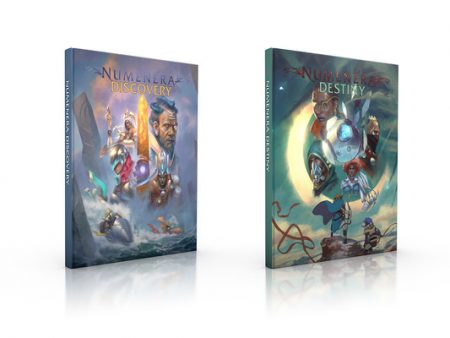
Numenera 2 - Destiny

My #RPGaMonth for October is Numenera 2 - Destiny, the latest incarnation of Monte Cook’s Numenera game.

What is Numenera 2?

Numenera 2 means that there are two core books. The first Numenera - Discovery is more or less the same thing that was already the first Numenera. One may look at reviews for that, the differences are small. The greatest being that you now have Player Intrusions as well. A player intrusion is the reverse of a GM intrusion. Instead of getting an experience point for a complication, you pay with an experience point for a greater positive effect which is described in detail in your character's type.

What is Numenera - Destiny?

So, Numenera - Discovery is about the players discovering the so-called Ninth World. The Destiny book is different. The focus of the campaign is on playing in a community setting. The players help to start a community, make it prosper and steer or influence it. The games here will likely be more bound to a specific location where your community may reside. Instead of sole exploration, the management of resources has now a great deal of importance.

The analogy might be like a part of the game Civilization where you start with the first city. You may pick a spot where the community starts or take over a site abandoned or something like that. The characters are now kind of the wise women or wise men which help develop everything. The game has two different play modes. There is the normal RPG part, where the characters act like before and interact with persons on a detailed and individual level. But there is also a long-term level, where each action is measured in full months. E.g. it takes 2 months to train the local people in defence, or 1 month to establish a new trade route or something like that.

The community itself is described in a couple of stats (mainly rank, health, armor, damage) and a couple of resources that are available, like how many pieces of Thaum Dust the community has stored, or how much food and water is produced.

Players action can change the stats of the community and different communities may interact with each other via their stats. Like the rank 2 killer robot tribe attacks a rank 4 community with health 20 and armor 1. On a successful attack the robot deal 2 points of damage, but due to the armor only 1 point of health is decreased. Probably the defences at the perimeter of the community were a bit lax, but nevertheless fast enough, such that only a few casualties occurred.

How does it feel playing?

We only did three sessions, so I can’t comment on long-term motivation, but it is really a different beast if you like me have played more or less only on an individual level. Playing the long-term actions has a certain feeling like role-playing a strategy game like Civilization. It is much fun and helps to overcome the limitations of such a computer game by the power of imagination. It is a bit like the modes in Microscope where you switch between a global view and a local narration. It gives you all those ideas, where to start a new individual RPG session. For example to build the protective force field that helps to mitigate the killer robot tribe problem mentioned above you need certain resources (long-term action “build force field”). To get those you may need to explore a certain abandoned site where the needed parts may be located (long-term action “find iotum”). But there are strange people living there with whom your community can probably trade, etc… You get the picture. In each of those cases you stay on the abstract long-term mode, but also switch to individual character mode, where the party explores the site and directly interact with the people there.

Final thoughts
Right now, I like the ideas very much. It is sometimes a bit fuzzy which level or mode to chose to play that, but it is so inspirational to think in a more big picture way. I will certainly come back to have a longer try. 


Freitag, 1. Juni 2018

Savage Worlds & "Das schwarze All"


 As my #RPG aMonth for May, I going to review Savage Worlds and a German-only setting book called "Das Schwarze All" (The black cosmos)


Savage Worlds


Savage Worlds is one of those RPGs the claim to be generic, i.e. it should work on all scales and for all kinds of settings. Certainly, you can play characters that act as heroes and shape the world around them.

 I have read the Deluxe Edition of the Savage Worlds which is just the core rules without setting specific details, but with notes on game mastering a beastiary and five one sheet adventures.

The whole document has 161 pages, but contains many pictures and let's be frank ads for setting books. The crunch starts on page 16, where traits (attributes), skills, edges/hindrances (advantages & disadvantages) are introduced. Instead of using plain numbers Savage Worlds uses dice to measure the abilities in traits and skills (from d4 to d12) similar to Cortex+. But instead of a pool like in Cortex+ you just roll your skill die together with an additional d6 called the wild card die and take the highest die. But the dice explode on the highest number, i.e. a 6 on d6.  The average ability for something a character learned is d6 and with the wild die, the chances fo succeeding a check which is always against 4 is 75%. For each additional 4 more than the initial 4 in the result your effect gets a raise, i.e., will get stronger.

On page 18 and 19 there stats für 16 archetypes that are simple characters that can be used as pregens without background or even as foes. An archetype or a character is just 7-8 lines without equipment and the only system with more concise character formatting I know of is Traveller. Next are rules for some specific races like elves and rules to create custom races, lists of hindrances, edges and skills.

The second chapter contains 17 pages of equipment from low tech to science fiction.

Chapter Three contains the standard game rules. It contains rules for trait and skill tests, combat, damage and healing. The most interesting part is that you have bennies to reroll tests, but not damage rolls, and also you can soak damage with it. A special thing for Savage Worlds is the use of card decks for initiative. Each player and the NPCs are dealt cards with determine the order. If someone gets a joker, there is a bonus on all actions for the character.

Chapter 4 contains a potpourri of situational rules, like mass combat, chasings, social conflict or travel for about 20 pages. Next is 20 pages of spells and powers.

A chapter on game mastering and a bestiary followed by 5 one page adventures complete the book.

For my one-shot session, I more or less ignored all situational rules from chapter 4, but we used all the rest of the game rules.

How does the game play feel? Fast and very versatile, but it did not click with me so far in a way that I would prefer to play Savage Worlds instead of other games.


"Das Schwarze All" (The black cosmos)

It is a 138 pages A5 hardcover. After a few pages of foreword, the actual setting section begins, in which the background is described. It is a somewhat over-excited SF parody, such as the The Ice Pirates. For me, the two most interesting things are the xylophilic, i.e. living trees that feed purely carnal, and the artificial intelligences, called E.P.I., which can take over physical beings. Otherwise, it's a collection of puns and many a joke that does not always meet my idea of humor. Of course, there are also various allusions to the classic German role-playing game The Dark Eye, but they are all rather lovingly done and very appreciating to the original. In short, the setting is a mixture of humorous space parody, but not so pointless that there would be no coherent overall setting. There is an empire, three different religous cults and some moreorless believable societies.

The second part of the book is dedicated to character creation, here are new races and backgrounds. For example, there are the backers, an ancient race of beings whose real appearance is unknown, and who walk around in protective suits that make them look like Vorlorn of the Babylon 5. The diggarz are actually quite classic fantasy dwarfs who live in space mines, mutants, novae (a kind of amazons) and xylophiles. Some values and talents are changed or adjusted and there is a new more pronounced version of PSI powers.


This is followed by a section of equipment that covers classic weapons but also microwave emitters or lightwave swords. The lightwave word has a sine wave-shaped blade of light as one may guess from the name. Then some sample spaceships from the space bike to an Imperial Freighter. Starting on page 98, the setting special rules, such as faster than light flight, the FreakRoll rocket or the set-box method for the equipment. Several pages with sample characters complete the work. From the point of playability, the book is great: even as a Savage Worlds noob, I could quickly pour my ideas into an adventure
with the help of the book. I just took the background setting and with the help of the sample ships and characters I had a nice one-shot ready. In short, the "Das Schwarze All" is just fun.